
A Reserve Bank-authorised survey on Monday lowered the country's economic growth rate projection to 5.7 per cent for the current fiscal, down from 6 per cent estimated earlier.
The PMEAC has revised economic growth rate upward to 7.1% for FY'12, up from 6.9% projected in advanced estimates.

Bullish over robust fundamentals and improving macroeconomic conditions, industry leader Deepak Parekh on Saturday said India currently has "exceptionally good conditions" in place to aspire for 10 per cent economic growth but much needs to be done to achieve that target.

'After the Galwan clash, the rules of engagement changed with the army commanders allowed to use any means at their disposal as they deem fit for tactical operations.'

Improvements in industrial activity and services sector mainly seems to have boosted GDP growth.

India has managed high government debt-to-GDP, a slowing domestic revenue engine, lower household savings and a more hostile geopolitical environment separately in the past. But together, they threaten to undo the growth narrative on which today's optimism rests, warns Debashis Basu.

The slowdown in India is related to a credit squeeze, which is a cyclical problem - not a structural problem: American economist Steve Hanke.
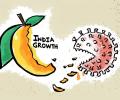
The International Monetary Fund (IMF) on Tuesday cut its economic growth forecast for India to 9.5 per cent for the fiscal year to March 31, 2022 as the onset of a severe second COVID-19 wave cut into recovery momentum. This forecast for 2021-22 is lower than the 12.5 per cent growth in GDP that IMF had projected in April before the second wave took a grip. For 2022-23, IMF expects economic growth of 8.5 per cent, larger than the 6.9 per cent it had projected in April.

The Indian stock market is poised for a volatile week, influenced by the Reserve Bank of India's monetary policy decision, crucial global macroeconomic data, and the escalating geopolitical tensions in West Asia, according to market analysts.

Sustaining 8 per cent-plus growth rates is necessary if we are to reach high-income status by 2047, points out Amitabh Kant.

Terming the 5.5 per cent GDP growth as "good news", Planning Commission Deputy Chairman Montek Singh Ahluwalia today expressed confidence that economy would rebound in subsequent quarters.
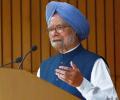
He said the 'toxic combination of deep distrust, pervasive fear and a sense of hopelessness in our society' is stifling economic activity and growth.
India's economic growth can reach a sustainable 10 per cent and be spread more evenly across the country if the government pursues ambitious and wide-ranging economic reforms, Organisation for Economic Cooperation and Development has said in a survey.

The overall breadth was positive as 1,593 stocks advanced while 1,295 stocks declined.

The country has been clocking a sub-5 per cent growth for the past two financial years, mainly on account of slowdown in investments.
Powered by a 9.2 per cent growth in the manufacturing sector, India's economic growth stood at 6.9 per cent for 2004-05 fiscal compared to 8.5 per cent during the previous financial year.
Credit rating agency ICRA on Monday revised upwards its economic growth projection to 6.5-6.7 per cent following Budget announcements that are likely to boost investment in agriculture and manufacturing sectors.

GVA growth in the manufacturing, farm and construction sectors tumbled.
India's projected 8.1 per cent GDP growth rate this year was "quite achievable" as investors' confidence had gone up substantially due to sustained economic reforms, a noted economist said on Monday.

Among Sensex firms, Bajaj Finance, Sun Pharma, Trent, Mahindra & Mahindra, State Bank of India and Bajaj Finserv were the major laggards. However, Tata Motors Passenger Vehicles, Maruti, Bharat Electronics, Kotak Mahindra Bank, Adani Ports and HCL Tech were among the gainers.
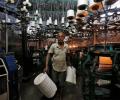
However, growth is expected to bounce back to an average of 7.3 per cent in the second half of 2017 and 7.7 per cent in 2018

* Repo rate reduced by 25bps to 5.25 pc; * 4th rate cut, totalling 125 bps, since February 2025; * MPC also decided to continue with neutral stance; * GDP growth forecast for FY26 raised to 7.3 pc from 6.8 pc;

Chief Economic Advisor Krishnamurthy Subramanian said India's economy will witness a decline in the current fiscal, but the drop will be limited if there is an economic recovery in the October-March period.

The previous high in quarterly GDP growth was recorded in the January-March quarter of 2015-16 at 9.3 per cent.

Moody's Investors Service on Thursday slashed India's economic growth projection to 8.8 per cent for 2022 from 9.1 per cent earlier, citing high inflation. In its update to Global Macro Outlook 2022-23, Moody's said high-frequency data suggests that the growth momentum from December quarter 2021 carried through into the first four months this year. However, the rise in crude oil, food and fertilizer prices will weigh on household finances and spending in the months ahead.
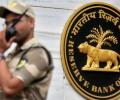
The Reserve Bank of India on Wednesday retained the economic growth projection for the current financial year at 10.5 per cent, while cautioning that the recent surge in COVID-19 infections has created uncertainty over the economic growth recovery. In its last policy review, the RBI had projected a GDP growth rate of 10.5 pc for FY'22. Taking various factors into consideration, it said, "the projection of real GDP growth for 2021-22 is retained at 10.5 per cent consisting of 26.2 per cent in Q1, 8.3 per cent in Q2, 5.4 per cent in Q3 and 6.2 per cent in Q4."

Fund managers advise conservative investors to cap midcap exposure at 10 to 15 per cent of their equity portfolio.

A shift appears underway in India's tax landscape. States with relatively smaller tax collections like Odisha and Telangana are emerging as the fastest-growing contributors to indirect and direct tax collections, respectively.

According to a research report by Bank of America Merrill Lynch, despite better rains the growth forecast for this fiscal is likely to be around 5.6 per cent.

New Delhi will substantially reduce tariffs on industrial and agricultural goods while continuing to protect sensitive sectors. Tariffs on some agricultural products that are not traditionally considered sensitive will be brought down to zero, while in the case of relatively sensitive items, duties will be reduced in a graded manner and quotas will be imposed.
Even after the government data showed a sharp fall in FY12 growth numbers and the April factory output data at a poor 0.1 per cent, a leading economic think tank on Thursday said it expects a revival in fortune and pegged GDP growth for the current fiscal at 7.3 per cent.

Gross GST collections rose 6.2 per cent to a three-month high of over Rs 1.93 lakh crore in January, indicating increased consumption is making up for rate cuts late last year, sources said on Sunday.
The Economic Survey 2022-23 (FY23), to be presented a day before Union Budget 2023-24 (FY24), is likely to project India's real gross domestic product (GDP) growth between 6 per cent and 7 per cent for FY24, Business Standard has learnt. The broader theme of the Survey could be on how India has dealt with two years of a global pandemic and the ongoing geopolitical disturbance, the strengths and weaknesses that emerged, and what lessons may be learnt. The much-awaited Survey will be the first one by Chief Economic Advisor V Anantha Nageswaran and his team in the finance ministry's economic division.

The measures announced by it risk backfiring, disrupting the foreign exchange market, and intensifying the very pressures they seek to contain, with broader consequences for the economy points out Rajeswari Sengupta.
India's growth outlook has weakened sharply this year, with a crunch that started with the non-banking finance institutions spreading to retail businesses, car-makers, home sales and heavy industries.

India's economic growth had slumped to a decade's low of five per cent in 2012-13.

The deal shifts the US posture towards India from hostile to neutral, and that matters for growth, points out T T Ram Mohan.
A stable government and more reforms are needed to hike growth beyond 6%.

Economy grew at 7.9 per cent in the fourth quarter of 2015-16 taking the overall GDP growth to a five-year high of 7.6 per cent in the fiscal, mainly on account of good performance of manufacturing sector.
